Agencies Act

Timeline

Searching for Survivors

Timeline

Revealed: The Hunt for Bin Laden

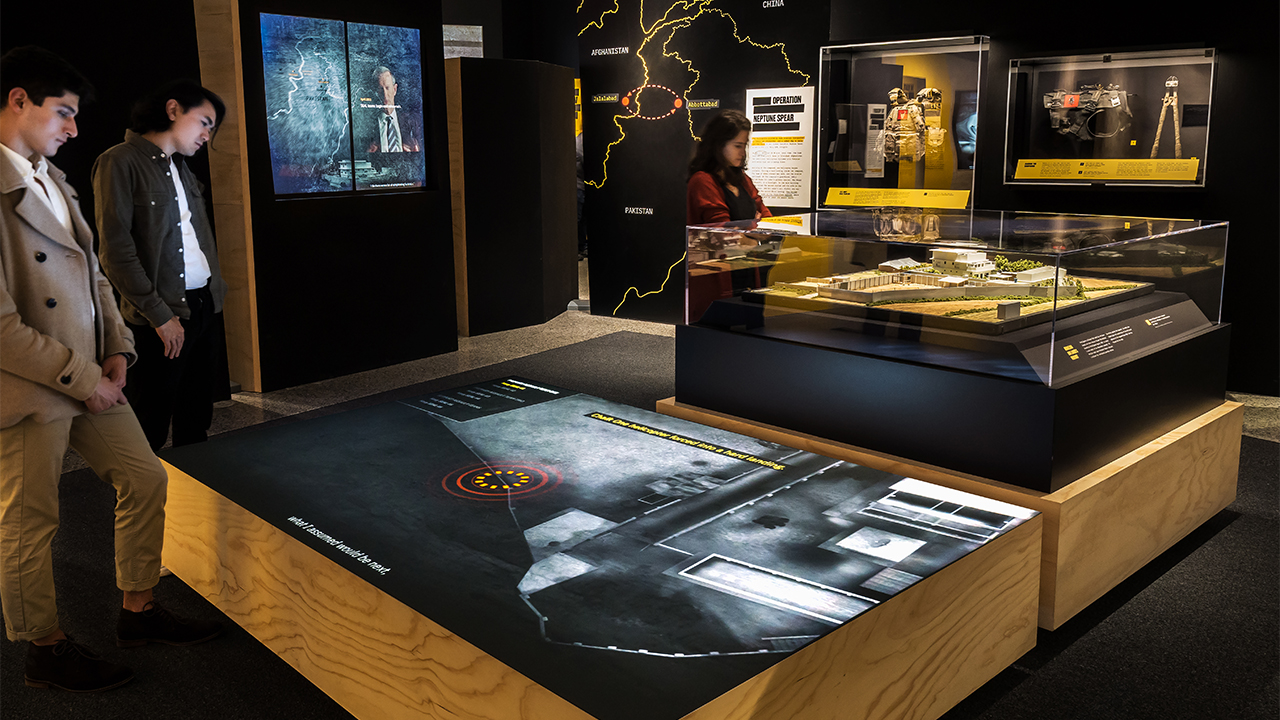
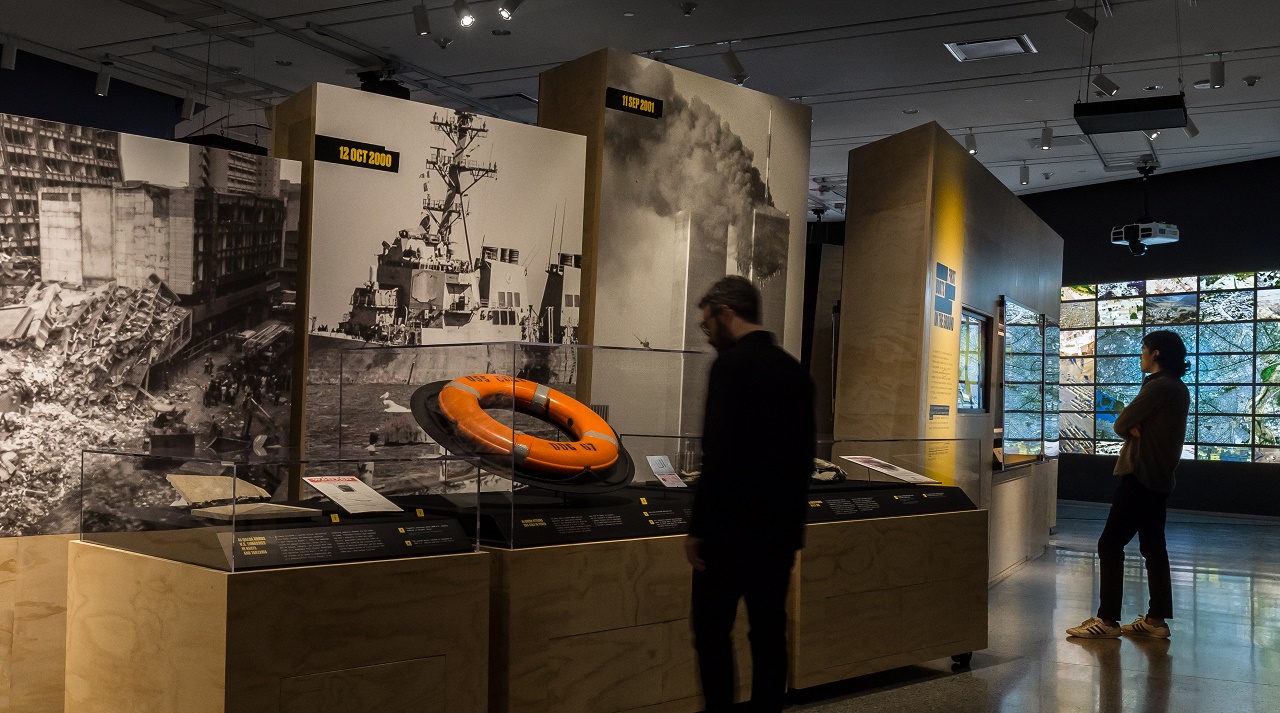
Two individuals observing installations in a gallery space.
Photo by C&G Partners

Revealed: The Hunt for Bin Laden

Told by those who were involved in the hunt for Osama bin Laden, this special exhibition sheds light on the intelligence and military activities that led to the raid on Osama bin Laden’s compound in Pakistan nearly 10 years after 9/11.

In a gallery space, two visitors watch a projected film on horizontal surface and a visitor looks at a display case.
Photo by C&G Partners

About the Exhibition

Revealed: The Hunt for Bin Laden leads visitors through the global hunt for Osama bin Laden, the founder and leader of the terrorist organization al-Qaeda. The story begins with the efforts before 2001 to monitor bin Laden’s whereabouts and to determine his plans and culminates in the U.S. Navy SEAL raid on his hideout in Abbottabad, Pakistan.

Visitors will hear from intelligence officers, law enforcement, and military members involved in the 10-year manhunt and will learn how intelligence collection and analysis evolved over the years to combat the changing landscape of terrorism. Eventually, by following a trail through the al-Qaeda network, the intelligence community pinpoints the location of a high-walled compound in Abbottabad, Pakistan, where a tall figure was known to be walking the grounds.

This exhibition gives visitors unprecedented access to the agencies and individuals who were involved in the hunt and conducted the culminating raid, known as Operation Neptune Spear. More than 60 artifacts, some newly declassified, are featured in the exhibition along with several immersive multimedia experiences. Revealed: The Hunt for Bin Laden tells a critical and powerful story of how the United States intelligence, military, and federal law enforcement came together after 9/11 with a single-minded focus to bring one man to justice.

Presentation of Revealed: The Hunt for Bin Laden has been made possible with the support of presenting sponsors Alexandria Real Estate Equities, Inc., and Palantir Technologies, as well as Lockheed Martin Corporation.

Objects on View

Now, nearly a decade after his death, those involved in tracking down Osama bin Laden have joined the Museum to share their experiences. In the exhibition, you will encounter artifacts that have never been shared with the public and hear firsthand accounts from intelligence officers, government officials, law enforcement agents, military leaders, and special operations forces.

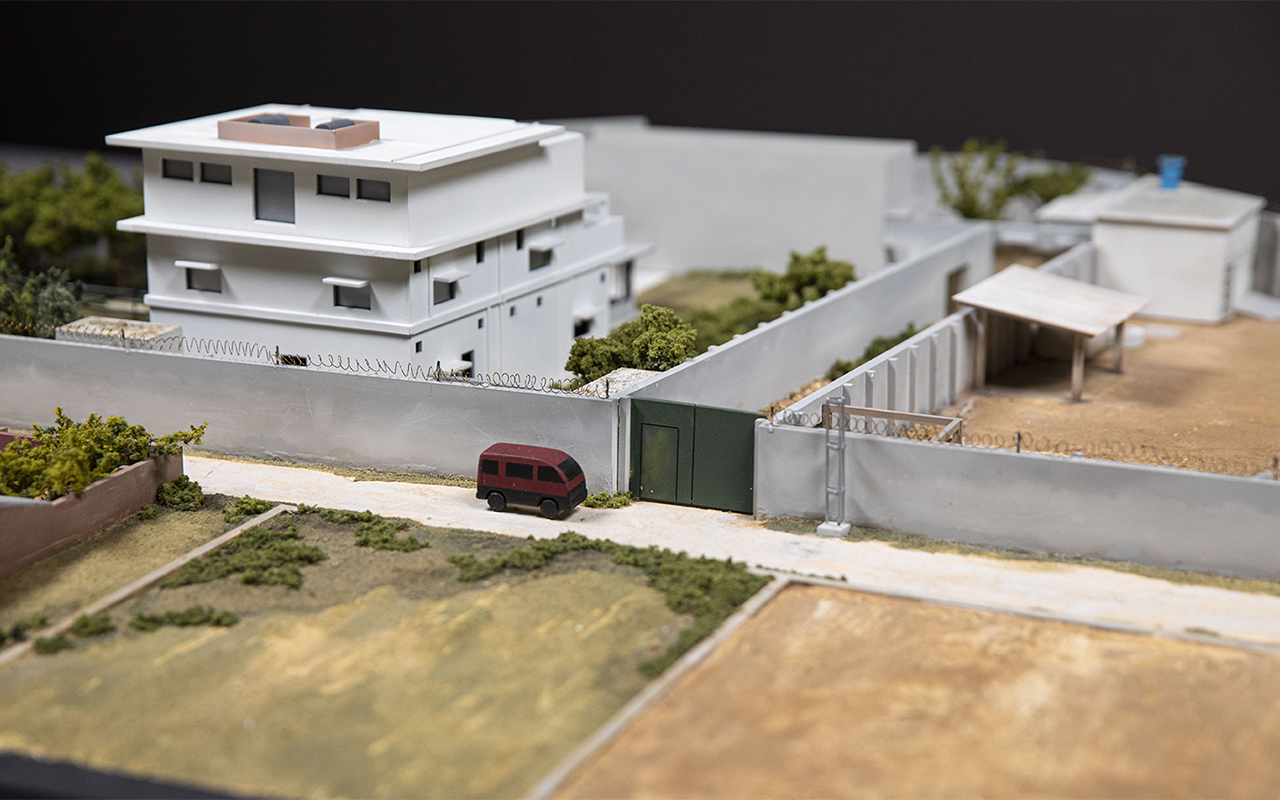
Model of Osama bin Laden’s compound used by U.S. officials in creating options for action

Courtesy of the National Geospatial-Intelligence Agency

This detailed model gave President Obama’s advisers a platform for considering possible options for action against the compound. The model also helped guide the construction of two full-size replicas of the compound where SEAL Team Six trained for the raid.

A model of the white and gray compound that housed bin Laden rests on a bed of dry-looking grass. A red courier van is parked out front.

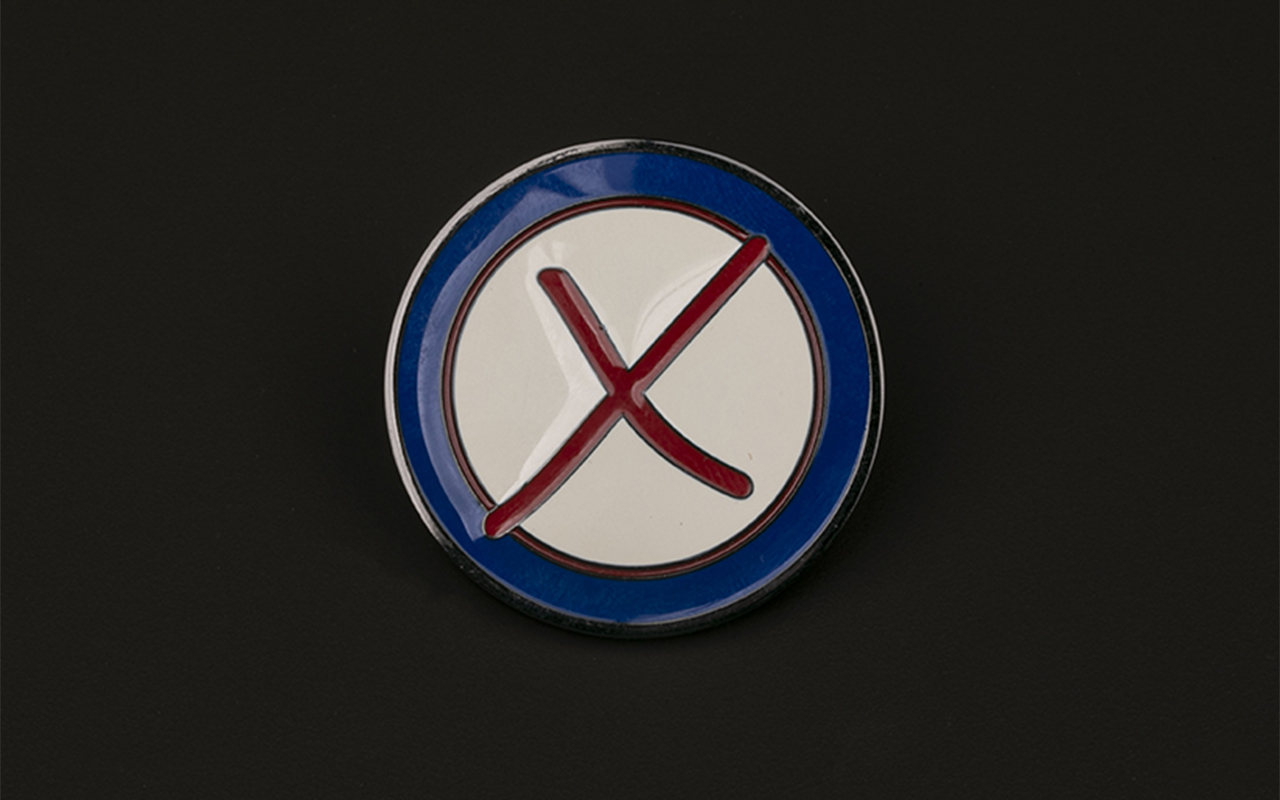
Operation Neptune Spear challenge coin

Collection 9/11 Memorial Museum, Gift of “Maya,” CIA officer

After 9/11, U.S. President George W. Bush kept a list in his desk of key al-Qaeda operatives still at large. Whenever one was exposed, arrested, or killed, he would make a red X mark through the assailant’s name.

A challenge coin with a raised red X in the center of an ivory circle and a navy blue border is suspended against a black background.

Related Events

Al-Qaeda Today

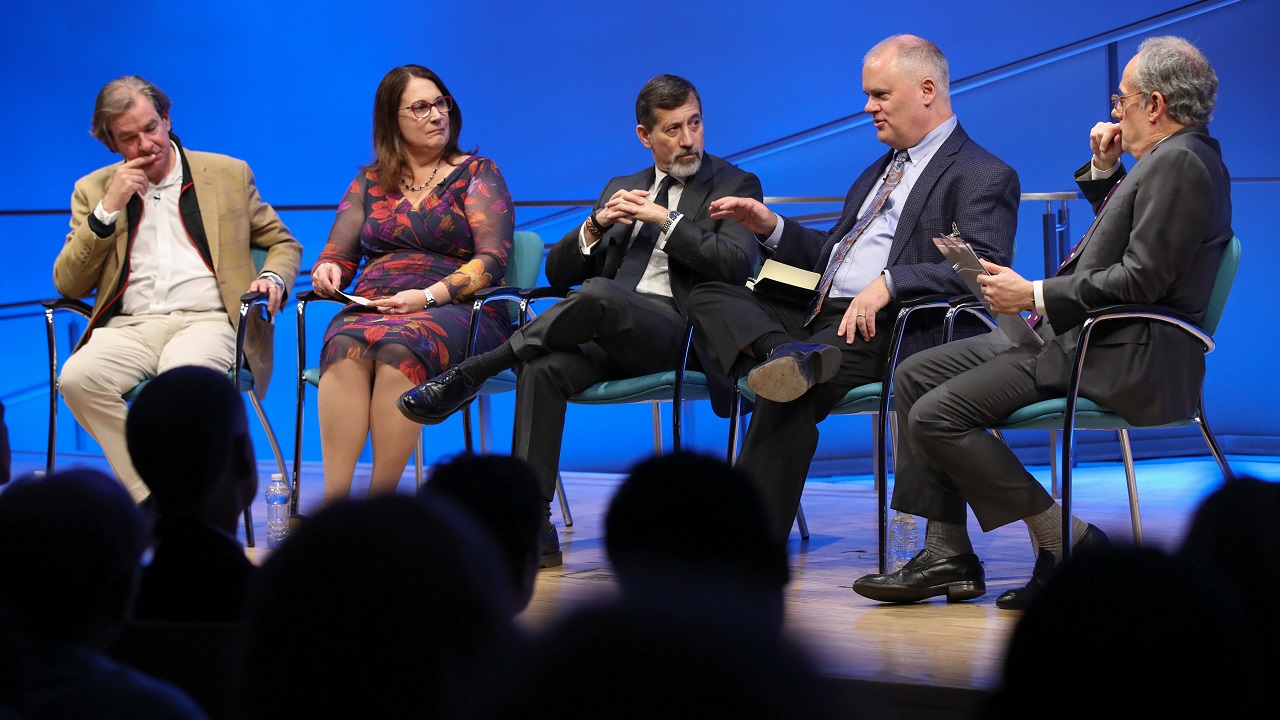
Mark Stout, who advised the Museum in the creation of the exhibition, speaks onstage at the Museum Auditorium as three people—al-Qaeda experts Peter Bergen, Bruce Hoffman and Mary E. Galligan—sit to his right looking on. Clifford Chanin, the executive vice president and deputy director for museum programs, sits to the left of Stout holding a clipboard. Audience members are silhouetted in the foreground.

To complement the 9/11 Museum's special exhibition Revealed: The Hunt for Bin Laden, al-Qaeda experts Peter Bergen, Bruce Hoffman, Mary E. Galligan, and Mark Stout discuss the future of the terrorist group.

Learn more

The Targeter: How to Hunt Terrorists

Author and former CIA analyst and targeting officer Nada Bakos sits onstage with Clifford Chanin, the executive vice president and deputy director for museum programs, as she takes part in a public program in the Museum Auditorium. Bakos gestures with her left and right hand as she looks at Chanin while speaking.

Nada Bakos recounts her experience as an analyst and then as a targeting officer, and gives an engrossing account of the intelligence work that helps to keep our country safe.

Learn more

2021 Nationwide Run/Walk

Join us Sunday, April 25, 2021, nearly 20 years after 9/11, as thousands of people unite across the country to ensure that the 9/11 Memorial & Museum can continue its essential mission of commemoration, education and inspiration. Together, we’ll collectively run and walk 20,000 miles as we fulfill our promise never to forget. Register today and get ready to run and walk together.

Horse Soldiers Visit the 9/11 Memorial & Museum

Horse Soldiers Visit the 9/11 Memorial & Museum

Six men known as the “horse soldiers” are seen in front of “De Oppresso Liber,” an 18-foot bronze statue depicting a Green Beret soldier on horseback at Liberty Park near the Memorial.
The horse soldiers in front of “De Oppresso Liber” on Tuesday, Jan. 16, 2018. Photo by Jin Lee, 9/11 Memorial.

Six soldiers from U.S. Special Forces Operational Detachment Alpha 595 – now known as the “horse soldiers” – visited the 9/11 Memorial Museum on Tuesday.

The soldiers, subjects of the new film “12 Strong: The Declassified Story of the Horse Soldiers,” were the first combat troops deployed to Afghanistan in the wake of the September 11 attacks. Because of the mountainous terrain in northern Afghanistan, the troops were provided with horses by Afghan tribes cooperating with the U.S. military. Many of the soldiers had never ridden on horseback before and were not expecting to fight cavalry-style on foreign soil.

Along with General Mulholland, the soldiers and their families received a special tour of the 9/11 Memorial Museum. The group also visited “De Oppresso Liber,” an 18-foot bronze statue depicting a Green Beret soldier on horseback, which was dedicated in Liberty Park in September 2016.

By 9/11 Memorial Staff

'The Movement Remains,' Two Scholars Address the Future of Jihadi Culture

'The Movement Remains,' Two Scholars Address the Future of Jihadi Culture

Thomas Hegghammer, Cole Bunzel, and Noah Rauch, senior vice president of education and public programs, sit onstage during a public program at the Museum auditorium.
Thomas Hegghammer, Cole Bunzel and Noah Rauch in conversation at the 9/11 Memorial Museum on Thursday, Nov. 30, 2017. Photo by Monika Graff.

Speaking at the 9/11 Memorial Museum on Thursday, Nov. 30, Thomas Hegghammer and Cole Bunzel, two scholars of jihadi culture, discussed how terrorist groups like ISIS recruit and create shared values among their supporters.

“Organizations come and go, leaders, not least, come and go, but the movement remains, and I think one of the reasons is the culture,” Hegghammer, senior research fellow at the Norwegian Defence Research Establishment, told Noah Rauch, senior vice president for education and public programs at the 9/11 Memorial & Museum. “Culture is the glue that binds these actors together and that keeps it alive, and it’s very hard to kill a culture. So that’s why I think we’re, unfortunately, stuck with this problem for many more years to come."

In the video clip below, Cole Bunzel, scholar of jihadi ideology at Princeton University, explains that ISIS’s diminishing control in the Middle East does not necessarily signal a weakening of the broader jihadi movement.

“So you see this great division right now going on in Syria. You see the jihadis having difficulty in Iraq and Syria in the Islamic State,” said Bunzel. “But at the same time, the broader jihadi movement as we understand it does not seem to be suffering. It’s still a movement that seems to be rather strong.”

To watch the program in full, please visit 911memorial.org/live. Find out more about upcoming programs at the 9/11 Memorial Museum here.

By 9/11 Memorial Staff

Frozen in Time: Wristwatch Tells Tale of Survival

Frozen in Time: Wristwatch Tells Tale of Survival

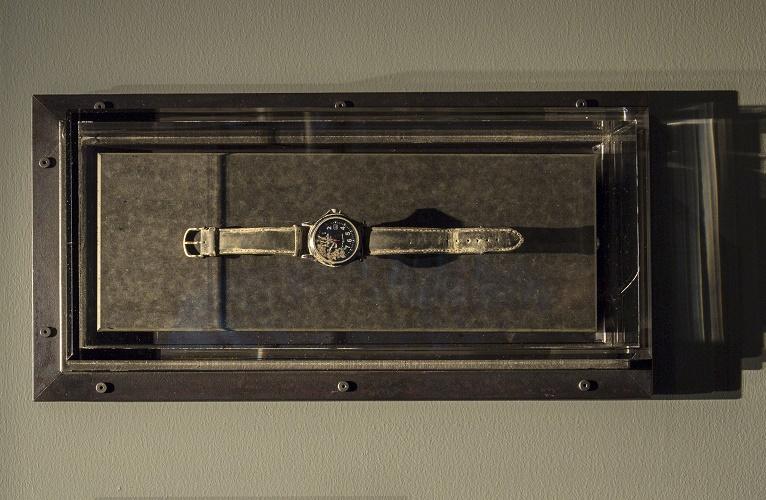
A dust-coated, battery-operated, and water-resistant men's wristwatch belonging to Tom Canavan is displayed at the Museum.
Collection 9/11 Memorial Museum, Gift of Tom Canavan in memory of the survivors as well as the fallen on 9/11/01. Photo by Jin Lee, 9/11 Memorial

Time stands frozen on the dust-coated, battery-operated and water-resistant men's wristwatch. The glass watch face has some dried blood residue from its owner, Tom Canavan, who survived one of the most tragic days in New York City history.

On the morning of September 11, 2001, Canavan went to work as a securities specialist for Unity Bank on the 47th floor of the World Trade Center’s North Tower. When Flight 11 slammed into the northeast face of the North Tower at 8:46 a.m., Canavan felt the entire building shake.

As a survivor of the 1993 bombing of the World Trade Center, Canavan immediately knew something was wrong and ordered his co-workers to evacuate down the building stairwell while he stayed behind to put securities into the vault. He was descending the stairwell when the second plane hit the South Tower. After stopping only once to pour water over an exhausted firefighter’s head, Canavan made his way down to the plaza.

Once out of the building, Canavan remembers feeling “a huge rush of air straight down, just like what I would imagine a wind tunnel was like, and the sound of a locomotive but one thousand times that noise.” The South Tower had collapsed.

Canavan survived the collapse but found himself buried underneath the wreckage. While attempting to climb above the rubble to safety, Canavan felt someone grab his leg. It was a security officer from the building. He and Canavan crawled an estimated 40 feet east and then another 30 feet up before they found a pinhole of light.

“[It was like] being in the eye of a hurricane. I could see blue skies straight up, but everything around me was swirling,” Canavan recalled after emerging from the rubble on Vesey Street.

While escaping up the street, he felt that familiar and terrifying rush of air again — the North Tower had fallen. Moments after making it to safety, his bloodied face and calm demeanor was captured by journalists. An iconic photo of Canavan is part of the Museum’s historical exhibition, wordless proof of how his watch became marred with blood.      

Today, Canavan is still very involved in the 9/11 community. Years after 9/11, he donated the watch he wore that day to the 9/11 Memorial Museum and currently works as the facilities dispatcher at the museum. When asked about that day, Canavan simply replies, “You get over the loss, but you never forget.” 

By Jared Lee, 9/11 Memorial Marketing Intern
Subscribe to