Bible Represents Compassion of First Responders After Attacks

Bible Represents Compassion of First Responders After Attacks

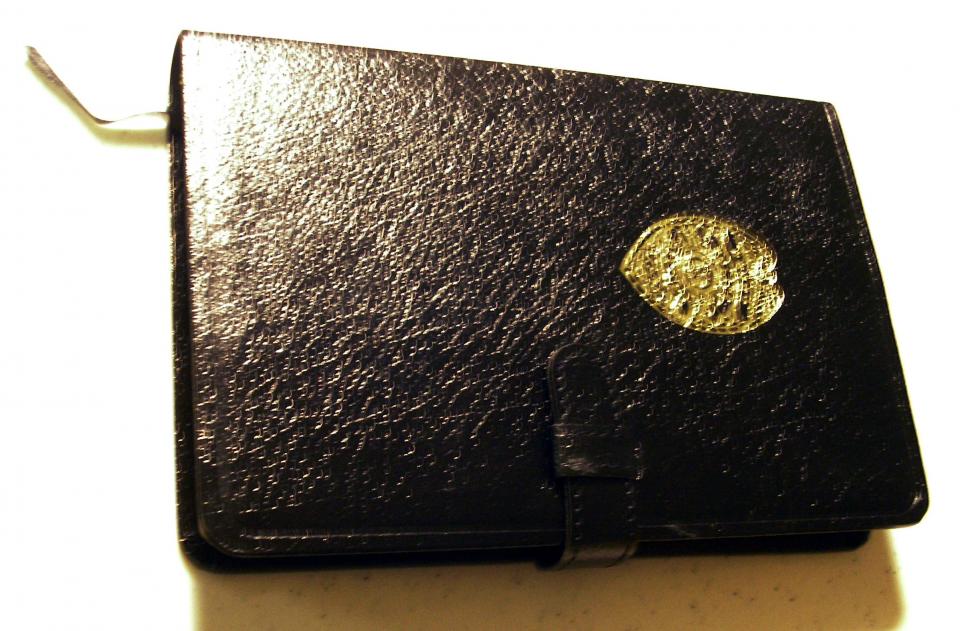
A black leather police officer’s bible is displayed on a white surface. It includes a gold police shield on its cover.
Police Officer’s Bible presented to the 9/11 Museum by Oklahoma City Police Department Chief Chaplain Jack Poe (Gift of Jack Poe).

A bible donated to the 9/11 Memorial Museum symbolizes the bonds of grief, compassion, hope and resilience shared by responders and survivors of terrorist attacks in both Oklahoma City and New York City. On the morning of April 19, 1995, Oklahoma City Police Department Chaplain Jack Poe felt the ground shake violently as a bomb exploded at the Alfred P. Murrah Federal Building, eight miles from his home. Tuning into his police radio, Poe drove downtown, witnessing huge plumes of smoke, crushed cars and shattered glass as he approached the disaster scene. He spent the next few days and much of the following months comforting survivors, responders and relatives of those who had been killed, all the while knowing that his own friends and colleagues were among the dead.

Soon after the bombing, Poe met members of NYC’s police and fire departments who came to Oklahoma to respond to the disaster and offer their expertise in urban search and rescue. In an oral history he recorded with me, Poe said, “We were so glad that they were here because they were the experts in shoring up buildings and keeping buildings from collapsing. … They literally almost rebuilt the Murrah Building from the inside out, shoring it up so that it wouldn’t fall, so that our people could go in and continue their rescue and recovery operation … and we were so grateful for their response.”

Poe had no doubts about what he needed to do as soon as he learned that the Twin Towers had collapsed on September 11, 2001. By the afternoon of Sept. 13, he and a small number of other Oklahomans had secured an “angel flight” that carried them east despite the suspension of air travel in the U.S. Poe offered pastoral support to workers at Ground Zero and blessed bodies that had been recovered. A week later, he spoke at a memorial service for all uniformed responders killed at the World Trade Center on 9/11, honoring their sacrifice and offering comfort to those who attended, upon bible verses and lyrics to the song “Fallen But Not Forgotten.”

Poe’s full sermon was later published in a Police Officer’s Bible, a Christian bible with special devotional passages for law enforcement personnel in their mission to protect and serve. He donated a copy of the Bible to the Museum in 2007 when staff from the 9/11 Memorial visited Oklahoma City.

By Amy Weinstein, Associate Director of Collections/Senior Oral Historian

More Tributes Featured on Museum Interactive

More Tributes Featured on Museum Interactive

A man in Foundation Hall uses an interactive touchscreen that is displaying a photo of an International Brotherhood of Electrical Workers sticker that is on the Last Column.
The IBEW sticker is one of the new Last Column tributes that is being featured on the interactive touchscreens in Foundation Hall. (Photo: Jin Lee)

The Last Column was the final steel beam ceremonially removed from Ground Zero, marking the formal end of the nine-month recovery effort following the 9/11 attacks. Standing 36 feet high, the Last Column – which is on view in the 9/11 Memorial Museum’s Foundation Hall – is covered with mementos, memorial inscriptions and missing posters placed there by ironworkers, rescue workers and others after 9/11.

Museum visitors can learn more about the different Last Column tributes using interactive touchscreens. This week, the Museum has added information about the following tributes:

• United Airlines sticker: A small sticker placed beside large orange letters reading “FDNY 343” bears the 2001 logo of United Airlines and was likely placed on the Last Column to commemorate the 16 crew members and 84 passengers killed aboard two United Airlines flights on 9/11.

• IBEW sticker: International Brotherhood of Electrical Workers (IBEW) member Kevin Flynn affixed a sticker to the Last Column to honor the 21 members of IBEW who were working at the World Trade Center and killed on 9/11.

• Memorial poster for firefighter Gary Paul Geidel: A firefighter for NYC Fire Department Rescue Company 1 for nearly 20 years, Geidel was killed in the North Tower on 9/11. While working on the site, his brother wore a helmet displaying a photograph of his missing brother – the same image as the one on his Last Column memorial poster.

• PAPD Team Romeo Marking: Team Romeo was a group of retired Port Authority Police Department officers who aided in recovery efforts following 9/11. The name came from the retired status of its members, employing the phonetic alphabet traditionally used for radio transmissions. “Romeo” stands for the letter “R.”

• OSHA markings: The Manhattan office of the Occupational Safety and Health Administration (OSHA) located on the top floor of 6 World Trade Center was severely damaged on 9/11. OSHA was one of the federal agencies active at Ground Zero. Several staff members signed the Last Column before its removal.

By 9/11 Memorial Staff

Shoes Symbolize Acts of Compassion During 9/11 Evacuations

Shoes Symbolize Acts of Compassion During 9/11 Evacuations

A pair of brown leather dress shoes owned by a 9/11 survivor are displayed on a white surface in the Museum.
Fred Segro, a 9/11 survivor at the WTC, recently donated these shoes to the Museum. (Photo: Jin Lee)

The 9/11 Memorial Museum recently acquired a new pair of men’s shoes for its permanent collection. The brown oxford shoes were donated by Freg Segro, a consulting IT recruiter and survivor of the 9/11 attacks. Ordinary in appearance, the shoes symbolize the acts of compassion and kindness extended in the face of disaster.

On 9/11, Segro was at work in his office located on the 77th floor of the North Tower. When Flight 11 hit the building at 8:46 a.m., the glass entrance shattered, injuring the pregnant receptionist, Julie, who was at her desk nearby. After tending to Julie’s wounds, Segro and a group of colleagues began a stairwell evacuation.

The stairs were slippery with water from the overhead fire sprinklers, making the descent difficult for Julie, who was wearing high heels. Concerned for her safety, Segro convinced her to leave her shoes, joking that he would later buy her a new pair. Once the group reached the lobby level and saw debris and glass on the floor, Segro removed his own brown oxford shoes and placed them on Julie’s bare feet.

Once safely out of the building, they took the advice of an EMT and made their way to Beekman Downtown Hospital to seek care for Julie’s injuries. Noticing a pair of abandoned women’s shoes along the way, Julie claimed them and returned Segro’s shoes to him.

Julie was treated for her minor injuries and medical staff confirmed that her baby was unharmed. With Julie taken care of, Segro evacuated home to New Jersey via ferry. The shoes changed hands a last time when Segro met with curators on February 23, 2015 to make the donation to the Museum.

Assistant Curator Alexandra Drakakis explains, “They are different from other shoes in the collection because while they don’t show the tell-tale signs of struggle, they represent one person’s commitment to the survival and safety of whoever was wearing them, and that is extraordinary.” 

By Jenny Pachucki, 9/11 Memorial Museum Content Strategist

Subscribe to