Make a donation to the Museum
Exploring First-Person Stories from 9/11
Exploring First-Person Stories from 9/11
- Grades 3 to 12
- Lesson Duration: 1 to 2 class periods
- Theme: Events of 9/11
Essential Question: How can educators utilize the Anniversary Digital Learning Experience Archives to create unique lessons addressing a variety of themes connected to 9/11?
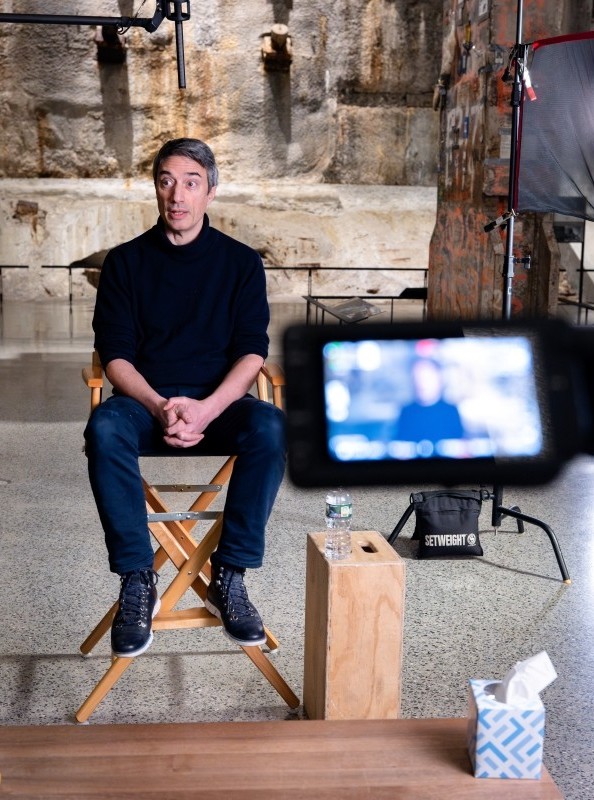
Image taken during the filming of the Anniversary Digital Learning Experience. Photograph by David E. Starke.
Learning Goals
Students will engage in primary source analysis of first-person narratives from a variety of 9/11 stakeholders.
Students will compare and organize their observations along thematic threads.
Vocabulary
Anniversary Digital Learning Experience (DLE) Archives: A collection of first-person narratives featuring 9/11 stakeholders sharing their stories from inside the 9/11 Memorial & Museum.
Next Generation: Refers to speakers in the Anniversary Digital Learning Experience Archives who were young on 9/11/01.
Activity
1. Familiarize yourself with the Anniversary Digital Learning Experience Archives (DLE Archives) by exploring a few of the stories before you begin lesson planning. This archive includes dozens of recorded testimonies from diverse 9/11 stakeholders. Each video is approximately 5-10 minutes long and includes a one sentence biography of the speaker and pre-written discussion questions differentiated by grade level.
2. Use the ‘category’ filter to toggle between the different speaker types. You can also use the ‘type’ filter to select videos with captions, ASL interpretation, audio description, or Spanish subtitles.
3. After exploring the DLE Archives, print the Teacher Planning Aid.
4. Select a focus for the lesson. To start, use one of the six speaker types as the primary focus of the lesson. The speaker types are:
- Family Members
- First Responders
- Military
- Next Generation
- Survivors
- Witnesses
- Note that many speakers fit into more than one category.
5. Using the planning aid, create a compelling question for students to explore. The question can be as simple as “What were the experiences of different types of first responders on 9/11?” or more complex depending on your learning goals.
6. Select 3-4 stories to use with students that best support your compelling question. Reviewing the short biographies and leveled discussion questions for each speaker can help narrow down the options. For each selected story, make note of key information or takeaways to discuss with students using the planning aid.
7. To begin the lesson, introduce the topic by letting students know that they will be using first-person accounts to investigate the experiences of a specific group of people on 9/11. Share the compelling question from step 6 and the specific group of stakeholders with students.
8. Screen this short film, which outlines the key events of the morning of 9/11 as a factual foundation for the activity.
Video: The Events of 9/11
Timeline Video
9. Divide students into groups and provide each with a computer or tablet and copies of the student worksheet. Tell students that they’re going to learn more about the experiences of the chosen focus group of stakeholders (this will depend on the speaker category you selected) by listening to a first-person story.
10. In the blank space at the top of the student worksheet labelled ‘Key Question,’ ask students to write in the compelling question from the planning aid.
11. Assign each group of students one story selected during the planning process and have them record their name on the graphic organizer. At they listen, they will use the ‘notes’ section of their graphic organizer to collect information to help them answer the key question. The graphic organizer includes these guiding questions to get them started:
- Where was the speaker on 9/11? What were they doing?
- How did they respond immediately on 9/11? How did they respond after the attacks?
- What is unique about this person’s experience?
12. Give students 10 minutes to listen to their story and work with their group to collect information. At the end of the 10 minutes, instruct each group to use the ‘conclusion’ section of the graphic organizer to record their answer to the ‘key question.’
13. Ask each group to briefly share what they learned about their speaker.
14. Conclude by returning to your key question. Ask students to share how they would answer it now, having watched their own story and heard from other groups.
Extension Activity
Depending on the area of interest, speakers can be combined across categories to address a significant number of additional themes. We encourage exploration of the full library of narratives to discover interesting connections. Here are a few examples:
Theme: Paired Perspectives
Key Question: How might two accounts of the same event shift our understanding of what happened?
- Jules and Gédéon Naudet
- Frank Razzano and Jeff Johnson
- Mark Lewis and Kathy Dilaber
- Dr. Kerry Kelly and Dan Jost
Theme: 9/11 Health Effects
Key Question: How have 9/11-related health effects impacted people in the years since the attacks?
Theme: Stories of Survival from Inside the Towers
Key Question: What challenges did people face as they evacuated the Twin Towers?