The Lens: Capturing Life and Events at the 9/11 Memorial and Museum

The Lens: Capturing Life and Events at the 9/11 Memorial and Museum

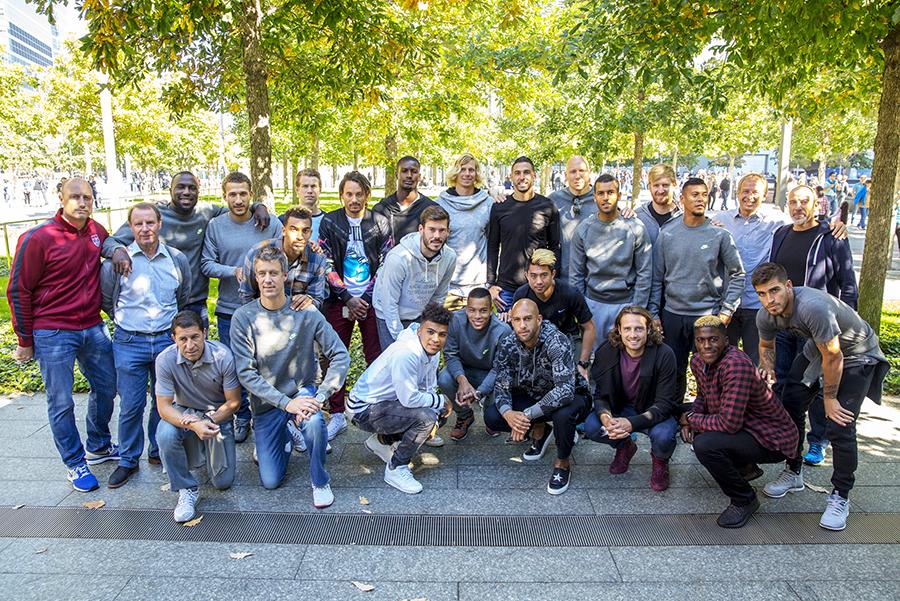
The U.S. men’s national soccer team poses for a photo during their visit to the 9/11 Memorial.
The U.S. Men's National Team at the 9/11 Memorial. Photo by Jin Lee.

The Lens: Capturing Life and Events at the 9/11 Memorial and Museum is a photography series devoted to documenting moments big and small that unfold at the 9/11 Memorial and Museum.The View: Members of the U.S. Men's National Team, including Tim Howard, pose for a photo on the 9/11 Memorial. The team visited the Memorial and Museum on Monday, October 12. 

By 9/11 Memorial Staff

Same Spot, Different Photo: Daughter Mirrors Mother’s NYC Trip

Same Spot, Different Photo: Daughter Mirrors Mother’s NYC Trip

These two photos show Marcela Segovia and her mother posing for the same photo at the World Trade Center decades apart. Segovia is standing in front of One World Trade Center in 2015 and her mother is standing in front of the Twin Towers in 1993.
At left: Marcela Segovia’s mother in front of the Twin Towers in 1993. At right: Marcela Segovia in front of One World Trade Center in 2015. Photos courtesy of Marcela Segovia.

In 1993, Marcela Segovia’s mother traveled around New York City taking photos of herself with famous landmarks, including the Twin Towers. Twenty-two years later, her daughter sought out to recreate the same trip, and photos, that her mother had experienced. Segovia, 19, recently completed a one year stint living in New York and during her stay, she visited the World Trade Center just as her mother did when she was 19 years old. Segovia said when she approached the 9/11 Memorial, she noticed that there was one photo of her mother’s that she could not recreate.

At top: New York City skyline in 1993. At bottom: New York City skyline in 2015. Photos courtesy of Marcela Segovia.

"When my mom took her picture, it was 1993 and she got a picture with the Twin Towers. Now 22 years after that, I can take a picture in almost the same spot, but not with the same building," Segovia told the 9/11 Memorial. Her photos not only capture the feeling of standing with the Twin Towers, but also how the towers highly impacted the NYC skyline.

By Claire Gallo, 9/11 Memorial

Teaching Students About 9/11 With Personal Stories

Teaching Students About 9/11 With Personal Stories

Shannon Elliott, a 9/11 Memorial education specialist, gives a Museum tour to students in Memorial Hall. The students are holding clipboards as they listen to her.
Shannon Elliott, a 9/11 Memorial education specialist, gives a Museum tour to students. Photo by Jin Lee.

As an education specialist at the 9/11 Memorial Museum, I find the most meaningful moments are when students, many of whom are too young to have lived through the day, make connections to the event through personal stories. This summer, a group of teenagers from Youth Consultation Services—an organization in New Jersey that provides behavioral and mental health services to children and young adults—had the opportunity to make a deeply personal connection to 9/11 thanks to the Todd Ouida Children’s Foundation.
 

Todd Ouida was one of the 658 employees of Cantor Fitzgerald killed at the World Trade Center on 9/11. Later, his family created the Todd Ouida Children’s Foundation, in part, to "financially support psychological services for children of families in need and promote mental health initiatives for all children,” according to its website. As a child, Ouida suffered from a panic disorder so severe that he was unable to attend school from fourth to sixth grade. However, with the help of a child psychiatrist and support from his family, he returned to school, graduated as an honors student from River Dell High School in New Jersey, and attended the University of Michigan before accepting a job at Cantor Fitzgerald.

For many of the teenagers who visited the Memorial and Museum, Ouida’s story resonated deeply. “I could relate with some of the people here because they’ve been through a lot and they went through a lot of pains, but they still stood their head up,” John, 15, whose last name was withheld, told the Bergen Record.

My colleagues and I are grateful to have had the opportunity to tell Ouida’s story and witness the impression it made on the group. Sharing these moments with students makes our job all the more meaningful.

By Shannon Elliott, 9/11 Memorial Education Specialist

Note: Shannon and our other education specialists give classroom workshops Monday through Friday each week. 

Blair: ‘Peace and Knowledge’ Needed in Fight Against Extremism

Blair: ‘Peace and Knowledge’ Needed in Fight Against Extremism

Tony Blair, the former prime minister of Britain, talks at a podium at the 9/11 Memorial Museum.
Tony Blair, former prime minister of Britain, talks at the 9/11 Memorial Museum. Photo by Jin Lee.

Security designed to contain and prevent terrorism since 9/11 is important, but not the only answer in confronting violent extremism worldwide, said Tony Blair, the former prime minister of Britain. The ideology that propels religious-based extremism also must be met head on with far-reaching education and true understanding. "If the roots are deep, we have to go down to them and uproot the poisonous growth," Blair said yesterday, speaking at the 9/11 Memorial Museum. "We have to replace the seeds of hatred and ignorance with those of peace and knowledge."

Since leaving office, Blair, through work at the Tony Blair Faith Foundation, continues the fight against religiously-based extremism, 9/11 Memorial President Joe Daniels said. "Many of us here recognize the great debt that America owes to Tony Blair, who pledged immediately after 9/11 that the UK would join fully in the fight against al-Qaeda and violent jihadism," Daniels said. "[He] stood by his word, at a real political cost, and remains one of America’s strongest and most loyal friends." Blair’s speech coincided with the release of a report by his foundation’s Centre on Religion & Geopolitics. The "Inside the Jihadi Mind" report investigates the common ideology shared through propaganda by three leading extremist groups.

By 9/11 Memorial Staff

A Look at the Flight 93 National Memorial in Pennsylvania

A Look at the Flight 93 National Memorial in Pennsylvania

Four visitors walk by the wall of names at the Flight 93 National Memorial in southwestern Pennsylvania.
The Wall of Names at the Flight 93 National Memorial in southwestern Pennsylvania. Photo credit: National Park Service.

The first time I saw it, on a foggy autumn day several years after that fateful September that thrust it into history, the windswept field atop a hill in southwestern Pennsylvania into which Flight 93 crashed appeared remote and desolate. But the wind, the rain, and the mist that greeted me somehow mysteriously echoed the vibrant presence of the people on that plane and their stunning act, and the small memorial site that was in place then gave material witness to the care and the attention of those who, like me, had come to the site to reflect on the meaning of the crash of Flight 93. The gifts and notes left by visitors attested to the awed gratitude they felt in this space that otherwise gave no indication of the awful thing that had happened there.

Now, nearly 14 years since the day of the event, the small temporary memorial has given way to a majestic permanent monument to the last day of Flight 93. Construction is still ongoing, but the Flight 93 National Memorial already presents itself as a worthy peer to the 9/11 Memorial in lower Manhattan.

In Pennsylvania, you experience the profundity and power of the natural landscape of this slice of American heartland that became the scene of dreadful tragedy. You walk the flight path and imagine what might have been in the minds of those men and women as they performed the deed that almost certainly spared a third target in the sights of the hijackers. You stand before the wall separating visitors from the Sacred Ground where the plane struck earth and ponder the stunning last moments of those whose mortal remains lie in that cemetery of heroes. After the crash, most of the plane came to rest beneath the loose soil of this former mining site, and there was little else in this rural field left after the crash in the way of material to which a memorial narrative could be linked. The task of the Flight 93 National Memorial was to give form to such a narrative, and its various planned features, from the Tower of Voices to the Wall of Names that leads to the Sacred Ground, do so in a way that is at once historically informative and emotionally moving.

I spent several years researching the memorial efforts in Pennsylvania and writing my book Angel Patriots about Flight 93. During this time, I came to understand much about this event and these people. Unexpectedly, I learned how much the story of that plane and those passengers is a story about all of America. The Flight 93 National Memorial makes that awe-inspiring story available to all who visit.

By Alex Riley, Professor of Sociology, Bucknell University

The Lens: Capturing Life and Events at the 9/11 Memorial and Museum

The Lens: Capturing Life and Events at the 9/11 Memorial and Museum

Red and white roses have been left on the bronze parapets at the 9/11 Memorial.
Tributes left on the 9/11 Memorial. Photo by Jin Lee.

The Lens: Capturing Life and Events at the 9/11 Memorial and Museum is a photography series devoted to documenting moments big and small that unfold at the 9/11 Memorial and Museum.The View: Flower tributes left on the northeast panels of the north pool at the 9/11 Memorial.

By Jenny Pachucki, 9/11 Memorial Content Strategist

Subscribe to