The 13 Year Journey of the 9/11 Museum’s First Artifact

The 13 Year Journey of the 9/11 Museum’s First Artifact

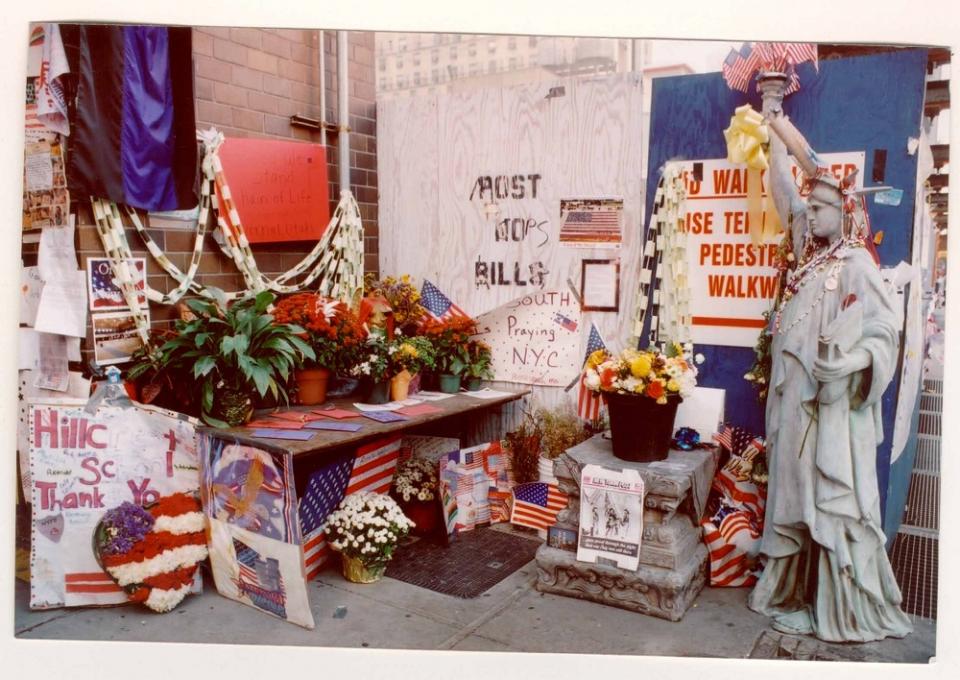
The Lady Liberty statue stands outside Battalion 9 firehouse in September 2001. Dozens of other tributes, including American flags and flowers, have been placed in an area beside the statue.
Lady Liberty outside of the Battalion 9 firehouse in September, 2001. Photographer unknown.

Where she originally came from remains a mystery, but in the days following Sept. 11, a nearly 11-foot Statue of Liberty replica appeared outside the Engine 54, Ladder 4 firehouse in Midtown Manhattan. The replica, which is viewed as a symbol of the city’s resilience, strength and compassion, would find its way to the 9/11 Memorial Museum after a 13-year journey.

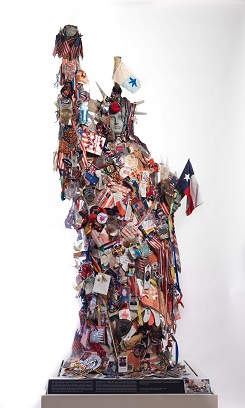
In the time that it stood guard outside of the busy firehouse, the fiberglass statue transformed into a spontaneous, collective memorial. Wanting to pay respects to the house that lost 15 men on 9/11, members of the public adorned Lady Liberty with tribute items, flags and hopeful messages.Lady Liberty. Photo: Bruce White.

In late 2001, with winter weather approaching, the house relocated Lady Liberty to the Intrepid Sea, Air and Space Museum where she became the center of an exhibit about 9/11. She continued to acquire tributes while on display at the aircraft carrier, including memorial items from victims’ families.     

When the Intrepid closed for renovations, the 9/11 Memorial Museum began working with the FDNY to take the artifact into the museum's collection. In late 2006, Lady Liberty became the new museum’s first major acquisition.

“It may have started out as a gesture to one firehouse, but it performed as a collective alter of grief and respect,” Chief Curator Jan Ramirez said. “It is the co-mingling of shock, pride and compassion all tied up in tributes to the most famous of New York City icons. There isn’t anything more symbolic of New York City than the Statue of Liberty.”

With the museum under construction, she was placed in the museum’s offices, and ultimately installed in the museum in 2013. A team of conservators and art handlers oversaw each move to protect each of her fragile tributes.

Her image is now the center of the National September 11 Memorial & Museum's "Our City. Our Story." awarness campaign designed to engage more New Yorkers through messages of hope and endurance. 

By Jenny Pachucki, 9/11 Memorial Content Strategist

9/11 Memorial Interpretive Guide Shares Memorable Moments

9/11 Memorial Interpretive Guide Shares Memorable Moments

Nicole Richardson leads a tour on the 9/11 Memorial plaza. A group of visitors stand and watch her as she speaks in front of a reflecting pool on a sunny day.
Nicole Richardson leading a tour on the 9/11 Memorial plaza. Photo: Jin Lee.

“Where were you on 9/11?” That question is often posed at the end of my guided 9/11 Memorial tours. From there, I launch into describing my memory of a then-13-year-old girl who sat at her window, watching plumes of thick black clouds drift up toward midtown Manhattan.

Now as an interpretive guide, some 14 years later, I provide visitors to the 9/11 Memorial with an understanding of the historical context of the attacks at the site where they transpired. But it is through the tours that I have become acutely aware of how 9/11 resonates with people differently.

Slowly the gravity of being on the site settles in. A beautiful day on the Memorial plaza juxtaposed by the tragedy that occurred nearly 14 years prior. I share the stories of the men, women and children whose names are inscribed on the bronze panels around the Memorial pools. It's through these remembrances that we learn about the lives these individuals lived.

I see my groups trying to reconcile how their own stories fit into the mosaic of a shared global experience; a form of catharsis. A family in Australia who woke up at night to the news of a catastrophic event on the other side of the world. A young woman whose high school prom date 10 years prior worked in one of the Twin Towers. The former New Yorkers who return to an unrecognizable landscape of lower Manhattan.

I watch visitors take in the names and the pools, and how their emotions shift. Sometimes we cry together. One afternoon in the middle of a tour, we all got emotional after seeing a white birthday rose stemming from the name of 11-year-old student, Bernard Brown. He would have turned 25 years old this summer.

Being able to share these moments and talk with people from all over who were affected by 9/11, makes being a guide all the more meaningful.

By Nicole Richardson, 9/11 Memorial Interpretive Guide 

Learn more about guided tours of the Memorial and Museum.

Honoring Purple Heart Day at 9/11 Memorial

Honoring Purple Heart Day at 9/11 Memorial

Vietnam War veteran Richard Cyril Rescorla poses for a photo in a formal military outfit.
Richard Cyril Rescorla pictured. Gift of the family of Richard Cyril Rescorla.

August 7 marks Purple Heart Day, commemorating the establishment of the Badge of Military Merit by George Washington in 1782. Following September 11, 2001, all members of the U.S. Armed Forces killed or wounded in the terrorist attacks were awarded the Purple Heart, a medal awarded to those who are wounded or killed while serving with the U.S. military. Examples of those courageous men and women honored on the 9/11 Memorial include Lieutenant General Timothy J. Maude, the highest ranking active U.S. military officer killed at the Pentagon on 9/11 and Richard Cyril Rescorla, a remarkable veteran from the Vietnam War.

According to a memorial website created by his wife, Rescorla served one tour in Vietnam, earning a Silver Star, a Purple Heart and Bronze Stars for Valor and Meritorious Service. However, his dedication to the safety of others did not halt when he returned from Vietnam and transitioned into civilian life.

On 9/11, Rescorla was vice president of security for Morgan Stanley at their headquarters in the South Tower of the World Trade Center. He is remembered for his emergency preparedness drills. On 9/11, he led a massive but well-organized evacuation of Morgan Stanley’s more than 2,500 employees, singing songs like “God Bless America” to keep his colleagues focused and moving downward. He was last seen walking back up the stairs of the South Tower to search for anyone left behind and was killed when the building collapsed. It was later determined that all but 13 of Morgan Stanley's work force at the World Trade Center had survived.

Rescorla’s courageous actions epitomize one of many heroic exploits on 9/11, some known and others unrecorded. His military identification tag from his service in Vietnam is part of the 9/11 Memorial Museum collection. His story has been recounted in the book, "Heart of a Soldier" by James B. Stewart and through the Rick Rescorla National Award for Resilience, presented annually by the U.S. Department of Homeland Security.

On Purple Heart Day 2015, the 9/11 Memorial honors all recipients of this prestigious military badge of merit.

By Christine Murphy, 9/11 Memorial Administration/Researcher

9/11 Artifact Tells Story of Sister’s Survival, Other’s Sacrifice

9/11 Artifact Tells Story of Sister’s Survival, Other’s Sacrifice

A white rose has been placed on the name of Wendy Wakeford at the 9/11 Memorial. An inset photo shows Wakeford smiling.
Birthday rose in Wendy Wakeford's name at the 9/11 Memorial. Photo: Gift of Ada Dolch.

Every September, Wendy Wakeford organized a family apple picking-trip to celebrate her belated birthday, August 6, and the September birthday of her sister Ada Rosario Dolch. Today, a white rose left in Wakeford’s name on the 9/11 Memorial commemorates Wakeford's birthday. The 9/11 Memorial Museum also houses an artifact that tells the story of her sister, Dolch, and her bravery on September 11, 2001.

Dolch, principal of Leadership and Public Service High School, was in the lobby of the school, located three blocks south of the World Trade Center, greeting students when the lights went out and she heard an explosion. At that moment, 8:46 a.m., a student informed Dolch that a plane had crashed into the North Tower. Realizing her sister was at work on the 105th floor of that tower, Dolch prayed “God, please take care of Wendy. I have to take care of the kids in my school.”

Motorola HT 1000 walkie talkie belonging to Ada Dolch. Gift of Ada Dolch.Students and staff witnessed the disaster unfold from the north windows of the school. Once the South Tower was hit, Dolch initiated the school’s emergency plan. She recalls thinking, ‘I’m not dying in this building.’

Relying heavily on her handheld radio to conduct the evacuation, Dolch directed her students and staff to safety in Battery Park. After being caught in the dust cloud when the South Tower collapsed, the students safely escaped the island via ferries to Staten Island and New Jersey.

Dolch walked home over the Brooklyn Bridge. She learned later that Wendy was killed when the North Tower fell at 10:28 a.m.  

In 2011, when she donated her radio to the 9/11 Memorial Museum, Dolch told curators, “That walkie talkie was so critical. It was the instrument I would use to speak to my assistant principals, to the deans and also to communicate with school safety, who communicated with the police.”

Now retired, Dolch is committed to spreading the message of love and hope. She helped establish a school in Afghanistan, which opened in 2005, in memory of her sister.

By Jenny Pachucki, 9/11 Memorial Content Strategist
Subscribe to